Navigating the Complexities of China’s Digital Ecosystem for B2B Marketers

A path leading to a city skyline at night.

Expanding China’s digital landscape is unlike any other in the world. For B2B marketers, understanding and leveraging its unique ecosystem is crucial to success. From the dominance of platforms like WeChat to the growing influence of Xiaohongshu and TikTok (Douyin in China), navigating this environment requires a tailored approach.


In this blog, we’ll explore the key platforms shaping B2B marketing in China, their unique functionalities, and how they differ from Western counterparts.


Why China’s Digital Ecosystem is Unique


China’s digital ecosystem operates within a "walled garden," meaning most Western platforms like Google, Facebook, LinkedIn, and Twitter are blocked. Instead, Chinese platforms dominate, offering highly localized and integrated features that blend messaging, content sharing, e-commerce, and CRM functionalities.


Unlike Western platforms, these tools are often more than social media—they’re ecosystems in themselves. For B2B marketers, this creates opportunities for deeper engagement and targeted outreach but also demands a nuanced understanding of these platforms.


Key Platforms for B2B Marketing in China


1. WeChat: The All-in-One Platform

WeChat, with over 1.2 billion monthly active users, is far more than a messaging app. For B2B marketers, its versatility makes it indispensable:


  • Official Accounts: A must for branding, content marketing, and customer communication.
  • WeChat Work (WeCom): A professional tool for client engagement, integrating seamlessly with the main WeChat app.
  • Mini Programs: Enable lead generation through interactive campaigns, virtual events, or product showcases.
  • Moments Ads: Highly targeted advertising within users’ feed.


Unlike LinkedIn, which focuses on professional networking, WeChat combines personal and professional connections, allowing B2B brands to build trust and nurture relationships over time.


2. Xiaohongshu: Visual Discovery Meets Business Influence

Xiaohongshu (Little Red Book) is often considered a consumer platform, but it’s increasingly important for B2B industries looking to target professionals in design, fashion, or tech.


  • Content Focus: Visual storytelling drives engagement, making it ideal for industries with visually appealing products or services.
  • Brand Credibility: Reviews, tutorials, and educational posts can position brands as industry leaders.
  • Trend Adoption: Use this platform to showcase your brand’s innovation or creative edge.


3. TikTok/Douyin: Short-Form Video for Brand Awareness

While TikTok is globally popular, its Chinese counterpart, Douyin, offers features specifically tailored to China’s market. Douyin’s emphasis on high-quality, localized video content can help B2B brands enhance visibility and humanize their offerings.


  • Video Campaigns: Highlight case studies, product demos, or behind-the-scenes stories.
  • E-Commerce Integration: Promote virtual events, webinars, or white papers directly through embedded links.
  • Trend-Driven Marketing: Stay agile and participate in trending challenges or hashtags to reach wider audiences.


How Chinese Platforms Differ from Western Counterparts
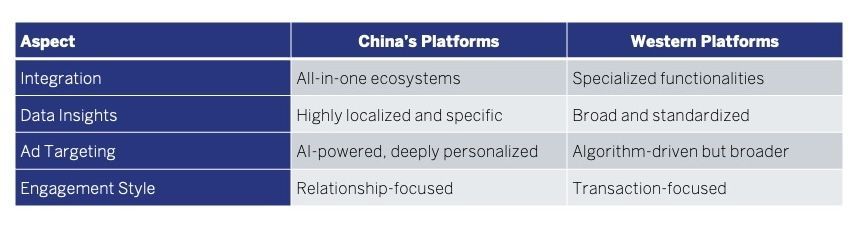
For B2B marketers, these differences underscore the importance of adopting a localized strategy. A simple content repost from LinkedIn won’t suffice—content must resonate with Chinese audiences in terms of tone, visuals, and functionality.


Tips for Success in China’s Digital Ecosystem


  1. Localize Content: Invest in translation and cultural adaptation to ensure your messaging connects with Chinese audiences.
  2. Leverage Mini Programs: These lightweight apps within platforms like WeChat can streamline lead capture and product showcases.
  3. Focus on Relationships: Build trust through consistent, value-driven content rather than hard selling.
  4. Experiment with New Formats: Video, livestreams, and interactive posts perform exceptionally well in China.
  5. Partner with Local Experts: Collaborate with agencies or consultants who understand the nuances of China’s digital environment.


Conclusion


China’s digital ecosystem presents unparalleled opportunities for B2B marketers, but it also demands a unique approach. By understanding the platforms, their functions, and the cultural context, B2B brands can unlock the full potential of this dynamic market.

Ready to take your B2B marketing in China to the next level? Let’s start the conversation.


China B2B marketing horse
By Michael Golden March 5, 2026
Compared with mature markets, marketing in China seems to consist of a prism of shifting goalposts and rules. In fact, no one can seem to agree on the size of the field or even what the goals should look like. Add in B2B as a general industry descriptor and it’s even worse: many of the players seemingly just took to the field, and everyone seems to be out of position or wearing some kind of homemade uniform. Sometimes I feel like an old school referee, blowing my whistle at outrageous fouls, mostly in vain. Now that we’re all stuck in my sports metaphor, I’m forced to pull in the dreaded Word of the Year 2021: the marketing playbook. What does it look like in 2026 for B2B marketers who are ready to up their game and bring some real talent to the pitch? Let me start with what’s not working anymore. That old approach of building massive contact lists and carpet-bombing them with messages? It’s dead. Worse than dead – it’s actively damaging your brand. I’ve watched companies spend six months scraping contacts only to see their email domains get blacklisted and their WeChat accounts flagged within weeks. The Chinese market has moved on, and if you’re still thinking in terms of volume, you’re already behind. What replaced it is something the industry folks are calling “high-velocity trust.” Fewer leads, but the ones you get are already halfway to buying because they’ve done their homework and decided you might be worth their time. Chinese business buyers have become very good at filtering out noise. The Video Reality Check Here’s where most international companies get it wrong. They hear “video content works in China” and immediately produce slick corporate videos. Then they wonder why nobody watches past the first fifteen seconds. Corporate videos have their place, but there’s a new shift in video. What actually works is something borrowed from consumer marketing called Zhong Cao – “grass planting.” It means planting seeds of interest through authentic content instead of trying to close deals through videos. For example: an engineer explaining how a solution solves a specific problem, or a consultant walking through a real case study. One client had their technical lead create simple WeChat Channels videos explaining industry misconceptions. No production crew, no script. Within three months their qualified lead flow increased by 40 percent. The platforms that matter most right now are: WeChat Channels Douyin Xiaohongshu (Rednote) The Data Privacy Wake-Up Call If you’re still buying contact lists or scraping data, stop. China’s Personal Information Protection Law is now being enforced and creates real legal risk. The better approach is “earn it, don’t take it.” Create valuable assets that prospects want: Diagnostic tools ROI calculators Self‑assessment tools Expert webinars When done right, leads arrive already educated and ready for real conversations. WeChat: Not What You Think It Is Many international companies treat WeChat like LinkedIn. That’s wrong. WeChat is the operating system for Chinese business relationships. Successful companies build integrated systems: Official Accounts for credibility Private connections for relationship building Mini‑Programs for lead capture connected to CRM When marketing and sales operate inside the same WeChat ecosystem, leads stop falling through the cracks. The AI Search Complexity Baidu still matters, but AI platforms are now shaping how buyers discover vendors. Companies must appear across a broader “trust ecosystem” including media outlets, Zhihu, and industry portals. Strategic PR is becoming critical again. Media articles and expert interviews: Improve search visibility Provide shareable sales content Build credibility The Real Talk Conclusion B2B marketing in China feels chaotic because it is. But underneath the chaos there is a clear shift: From interruption → education From volume → value From control → trust Companies that build authority before demanding attention are winning. The payoff is higher‑quality leads, shorter sales cycles, and stronger long‑term relationships. Key Takeaways What is high-velocity trust in B2B marketing? High-velocity trust is a lead generation strategy where companies focus on building authority and educating buyers so that prospects arrive already informed and closer to purchase. Why does traditional B2B outreach fail in China? Traditional outreach fails because Chinese buyers filter marketing noise aggressively, and privacy laws such as China’s Personal Information Protection Law make mass scraping risky. Which platforms matter most for B2B discovery in China? WeChat Channels Douyin Xiaohongshu (Rednote) What role does WeChat play in B2B marketing? WeChat acts as the operating system of Chinese business relationships where discovery, communication, and deal discussions often take place. Why is PR becoming important again in B2B marketing? Industry media, expert interviews, and trade publications provide trust signals that influence AI search and vendor discovery. This article originally appeared in the China 2026 B2B Trends Report, available for download here .
horse illustration over a city backdrop,
By Michael Golden February 9, 2026
The China 2026 B2B Trends Report covers all of the latest B2B Marketing strategies and tactics in China.
Woman with blonde hair, smiling, wearing a light blue top, resting her chin on her hand, against a gray background.
By Steven Proud January 23, 2026
Podcast on China marketing featuring Harriet Gaywood