GEO in China and What B2B Marketers Are Getting Wrong
Quick Summary
- Generative engine optimization (GEO) in China means building brand authority so that AI-powered answer engines — not just search rankings — surface your company when Chinese buyers research vendors.
- China has six major AI platforms (Baidu ERNIE, Alibaba Qwen, ByteDance Doubao, Tencent Hunyuan, Moonshot Kimi, and DeepSeek), each drawing from different data sources. Visibility on one does not guarantee visibility on others.
- A wave of agencies is selling GEO as a content volume play — publishing large quantities of keyword-stuffed articles across low-authority domains. This approach fails because Chinese LLMs weight authoritative sources, not content quantity.
- What actually builds GEO visibility: citation-worthy technical content, presence on platforms like Zhihu and Baidu Baike, consistent Chinese-language brand signals, and genuine third-party references.
- For international B2B companies, the window to build AI platform authority ahead of competitors is open now — but narrowing.
- Measuring GEO visibility requires purpose-built tooling; manual prompt testing gives snapshots, not trends.

What Is GEO, and Why Does It Matter in China?
Generative Engine Optimization (GEO) is the practice of structuring a brand's content, authority signals, and digital presence so that AI-powered answer engines include that brand in the responses they generate for relevant queries.
In China specifically, GEO refers to visibility across the country's major AI platforms — Baidu ERNIE Bot, Alibaba Qwen, ByteDance Doubao, Tencent Hunyuan, Moonshot Kimi, and DeepSeek — which Chinese business buyers are increasingly using to research vendors, evaluate suppliers, and conduct pre-meeting due diligence.
GEO is distinct from traditional SEO in one critical way: ranking algorithms reward relevance and technical optimization, while generative AI systems reward authority, citation, and accurate representation across trusted sources. A company can rank on page one of Baidu and still be invisible — or described inaccurately — in AI-generated answers.
There's a shift happening in how Chinese buyers research vendors, and most international B2B companies haven't noticed it yet. They're still optimizing for Baidu rankings, still measuring success by page-one placement, still treating search engine optimization as the ceiling of their China digital strategy. Meanwhile, the buyers they're trying to reach have moved on.
AI-powered answer engines are changing the first moment of contact between a Chinese procurement team and a foreign supplier. When a technical buyer in Shenzhen types a question like "which foreign companies supply industrial filtration systems for semiconductor fabs," they're no longer necessarily getting ten blue links. They're getting a synthesized answer. And if your brand isn't in that answer, you didn't lose the search. You were never part of the conversation.
Why B2B Is the High-Stakes Category
Consumer brands have the luxury of repeated touchpoints. A Chinese shopper might encounter a brand through Douyin, Xiaohongshu, a friend's recommendation, and a WeChat ad before making a purchase. B2B procurement doesn't work that way.
The research phase is compressed, structured, and often invisible to the seller. A procurement committee at a Chinese state-owned enterprise or a multinational's China sourcing team will typically run background checks on shortlisted vendors before the first outreach ever happens. Increasingly, part of that research involves querying an AI platform — not to get a recommendation, but to get a briefing.
What does the AI say about this company? What does it make? Who does it serve? These aren't questions buyers are outsourcing their judgment to answer definitively. They're using AI the way they'd use a knowledgeable colleague: to get oriented quickly before going deeper. If a Chinese AI platform has no meaningful information about your company — or surfaces a competitor in response to a query that should have included you — the damage is done before you know a prospect existed.
China's AI Platform Landscape: Not One Engine, Six Ecosystems
The first mistake most agencies make when pitching GEO in China is treating the market as monolithic. "Chinese AI" is not a category the way "Google" is a category. Each major platform has a different data diet, a different user base, and a different relationship with the broader corporate ecosystem it sits inside. What works to establish visibility on one may do nothing on another.
Platform Comparison at a Glance
| Platform | Parent Company | Primary Data Sources | Best For |
|---|---|---|---|
| ERNIE Bot (文心一言) | Baidu | Baidu search index, Baike, Wenku | SOEs, government-adjacent procurement, traditional sectors |
| Qwen (通义千问) | Alibaba | 1688, Alibaba Cloud, commercial ecosystem | Procurement, supply chain, industrial products |
| Doubao (豆包) | ByteDance | Douyin, Toutiao, creator content | Early-stage research, technical content discovery |
| Hunyuan (混元) | Tencent | WeChat, WeCom, Official Accounts | Trust signals, relationship-driven sectors |
| Kimi | Moonshot AI | Long-form documents, research content | Technical buyers, RFP-stage research, analysts |
| DeepSeek | DeepSeek AI | Open model, third-party deployments | Precision industries, advanced manufacturing |
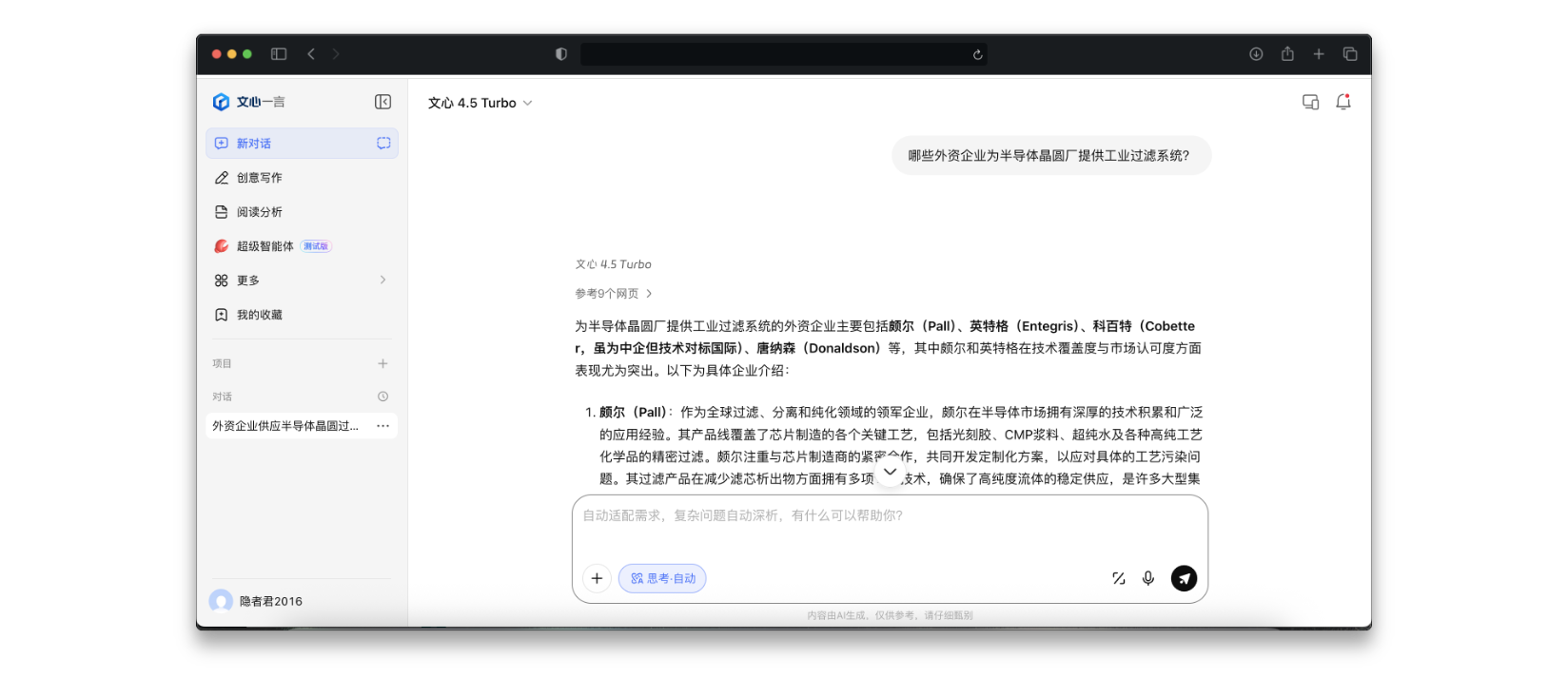
Baidu / ERNIE Bot (文心一言)
Baidu's AI platform has the tightest feedback loop with traditional search of any platform in the market. ERNIE Bot's training and retrieval architecture draws heavily from Baidu's own web index, which means that the fundamentals of Chinese SEO — Baidu Baike entries, indexed articles on high-authority domains, structured site content — still carry real weight here in a way they may not elsewhere.
For international B2B companies, this is both good and bad news. Good because there's an established playbook: build Baidu-indexed content, establish a Baike entry, get cited by Chinese media. Bad because most foreign companies still have thin or outdated Baidu footprints, and years of mobile-first thinking — WeChat over websites — has left their indexed content stale.
ERNIE Bot skews toward the demographics that have been using Baidu the longest: older enterprise buyers, government-adjacent procurement teams, established industrial players. And Baidu's integration of ERNIE across its search results page — showing AI-generated summaries above organic results for many commercial queries — means the distinction between "ranking on Baidu" and "appearing in ERNIE's answer" is already starting to collapse.
Alibaba / Qwen (通义千问)
Qwen sits inside one of the most commercially integrated ecosystems in China — the same corporate family that operates 1688 (the domestic B2B wholesale platform), Alibaba Cloud, Cainiao logistics, and a web of enterprise SaaS tools through DingTalk. Its training doesn't just draw from the web. It draws from Alibaba's commercial data environment.
Companies with strong 1688 profiles, Alibaba Cloud case studies, or presence in Alibaba's enterprise partner ecosystem have a natural advantage here. Companies that have never engaged with any Alibaba commercial platform are starting from a genuine deficit. The B2B buyer who uses Qwen is often in procurement, supply chain, or operations — looking for practical information: who makes this, who's used it, is there a China presence. For any international company selling industrial products, logistics solutions, or B2B technology into China, Qwen is not a secondary priority.
ByteDance / Doubao (豆包)
ByteDance's AI assistant draws from a content ecosystem anchored in Douyin and Toutiao. That makes it look, on the surface, like a consumer play. But the demographics of Douyin have matured considerably. The platform's early reputation as a Gen-Z entertainment app has given way to a much broader user base that includes entrepreneurs, technical professionals, and mid-level managers — exactly the cohort that often does preliminary vendor research before escalating to a formal procurement process.
Toutiao's article ecosystem is also a genuine GEO surface. Industry analysis pieces, technical explainers, and expert commentary published through Toutiao-connected channels get indexed and weighted by Doubao in ways that most B2B brands haven't taken advantage of. If your company has any content presence in Chinese, the ByteDance ecosystem is where that content is most likely to reach a buyer who hasn't yet entered a formal procurement process.
Tencent / Hunyuan (混元)
Hunyuan has the most direct integration with the tools Chinese business professionals use every day. WeChat and WeCom are the operating system of business communication in China, and Tencent's AI capabilities are embedded in both.
For B2B marketers, the implication is specific: your WeChat Official Account is not just a content distribution channel. It's a brand legitimacy signal that feeds into Tencent's AI infrastructure. Companies with active, well-maintained Official Accounts — publishing substantive content, maintaining consistent branding — are building an asset whose value increases as Hunyuan matures. The enterprise buyer who encounters your brand through WeCom, checks your Official Account, and then queries Tencent's AI tools is having a coherent, reinforced brand experience. The company with a dormant WeChat presence faces a gap at a critical point in that sequence.
Moonshot AI / Kimi
Kimi occupies a distinctive niche: long-context reasoning. While other platforms are built around conversational queries and quick answers, Kimi is designed to process and synthesize large documents — whitepapers, technical specifications, regulatory filings, lengthy reports. It's the platform a research-oriented buyer uses when they want to go deep.
The kind of buyer who uses Kimi is usually the most sophisticated one in the room: technical directors, R&D procurement leads, analysts building vendor dossiers. The GEO implication is direct — if you want to appear in Kimi's answers, you need source material worth synthesizing. A homepage that says "global leader in precision manufacturing" is not that. A technical whitepaper with specific tolerances, certifications, application data, and case study outcomes is.
Kimi rewards companies that have invested in serious technical content. If your only publicly available materials are marketing brochures, you are invisible to the most analytically capable buyers in your category.
DeepSeek
DeepSeek is the most complicated platform to optimize for, and one of the most important to watch. Its models are technically open — the weights are publicly available — which means DeepSeek itself isn't really a single platform. It's an engine being embedded inside dozens of other tools, applications, and interfaces across China and globally.
The opacity this creates is real. A manufacturing engineer using a technical tool that runs on DeepSeek in the background may be getting answers shaped by entirely different training data than someone querying DeepSeek directly. What is consistent across DeepSeek deployments is a preference for technically precise, well-sourced content. Vague marketing language doesn't perform. Specific, verifiable, technically accurate content does. For B2B companies in precision industries, advanced materials, or industrial equipment, DeepSeek may already be shaping how Chinese counterparts perceive your capabilities — whether you're aware of it or not.
The Backlash: When GEO Became a New Excuse for Content Farming
The awareness of GEO as a discipline has grown faster than the understanding of what it actually requires. As with every new marketing channel that gets attention in China, agencies have moved quickly to package and sell it — often without thinking clearly about what they're selling.
The version of GEO being pitched right now by some agencies is essentially the same content farm play that was sold as SEO circa 2012, with new language applied to it. Publish a high volume of AI-generated or templated articles seeded with category keywords, distribute them across as many domains as possible, call the resulting activity GEO. The implied logic is that flooding the zone with content will make AI platforms notice your brand.
This fails for several connected reasons:
- Chinese LLMs weight authoritative sources heavily. Government publications, established industry media, academic output, major commercial platforms — these are the sources that carry weight in training data. A thin article on a low-authority domain, regardless of how many keywords it contains, does not move the needle.
- AI platforms are not rewarding volume — they're surfacing citation. What matters is not how many articles mention your brand, but whether credible third-party sources reference your brand in meaningful contexts. You cannot manufacture that authority through output quantity.
- B2B buyers are specifically filtering for this pattern. A procurement engineer evaluating foreign suppliers will not be reassured by a brand appearing in dozens of identical-looking articles across low-quality sites. That pattern triggers skepticism — it looks like a company without real market presence trying to manufacture the appearance of one.
The content farm approach to GEO fails not just because platforms discount it — but because the B2B buyers those platforms are serving are actively looking for the signals that distinguish genuine authority from manufactured volume.
What Actually Builds GEO Visibility in China
The alternative to content farming isn't doing less. It's building the kind of presence that AI platforms are trained to recognize as authoritative.
Citation-worthy content is the foundation. Whitepapers with original data, technical specifications that go beyond the marketing brochure, genuine case studies with named outcomes. This is the content that Chinese industry media might reference, that a Zhihu contributor might cite, that a Baidu Baike editor might link to. Those secondary references — your brand being discussed by others in credible contexts — are the raw material that AI platforms synthesize into brand authority.
Zhihu and Baidu Baike carry disproportionate weight in Chinese LLM training data. A substantive Zhihu answer that references your brand is worth more from a GEO standpoint than many keyword-seeded articles on owned domains. A complete, accurate Baike entry creates an anchor that multiple AI platforms pull from when generating brand descriptions. Both are often absent for international companies and both are fixable.
Consistency across Chinese-language assets matters more than most marketers realize. Chinese AI platforms are sensitive to inconsistency — if your company name is romanized differently across platforms, if product descriptions conflict between your website and your Alibaba profile, if core capability claims vary from one article to the next, AI systems struggle to build a coherent entity model for your brand. The result is vague, hedged, or absent responses when a buyer queries you.
Measuring Success: The Metrics Gap Nobody Is Talking About
Most marketers who start taking GEO seriously run into the same wall: there's no Google Analytics for this. Traditional digital metrics — search rankings, organic traffic, impressions, click-through rates — don't capture whether your brand is appearing in AI-generated answers, how accurately it's being described, or how you compare to competitors across different platforms. You can do everything right and have no idea if it's working.
The current workaround is manual prompt testing. Run a structured set of queries across each platform, note what comes back, repeat the process a month later and see what's changed. It works well enough as a starting point — and we recommend every B2B brand do it before anything else — but it doesn't scale. It gives you snapshots, not trends. It can't tell you whether your visibility improved because of a specific piece of content, a new Zhihu citation, or a Baike edit. And it can't tell you what your competitors' AI share-of-voice looks like relative to yours.
What B2B marketers actually need is something closer to a share-of-voice dashboard: which queries surface your brand across China's AI platforms, how often, with what degree of accuracy, and how that changes over time. That kind of visibility turns GEO from a faith-based exercise into something you can actually manage.
The gap between "we're doing GEO" and "we know our GEO is working" is a data problem. And until recently, no tool existed to close it for the China market specifically.
Brandigo has partnered with a platform that does exactly this — purpose-built for tracking brand visibility across China's AI ecosystem, covering the major platforms and built around the queries that actually matter to B2B buyers. It's the first tool of its kind focused specifically on the China market. The core capabilities:
- Multi-platform coverage. Track your brand's presence and accuracy across all six major Chinese AI platforms in a single dashboard — not just the one or two your agency happens to test manually.
- Query-level reporting. See exactly which queries surface your brand, what the platforms say when they do, and where they get it wrong. Spot gaps and inaccuracies before a prospect does.
- Competitor benchmarking. Measure your AI share-of-voice against named competitors. Understand which players the platforms favour for your category queries and why.
- Trend tracking over time. Monitor how your visibility changes as you build content authority, fix platform signals, and earn third-party citations — so you can connect activity to outcomes.
Details on early access coming soon.
Frequently Asked Questions
What is GEO in the context of China marketing?
Generative engine optimization (GEO) in China refers to building a brand's content authority, platform presence, and digital consistency so that Chinese AI platforms — including Baidu ERNIE Bot, Alibaba Qwen, ByteDance Doubao, Tencent Hunyuan, Kimi, and DeepSeek — accurately surface that brand in AI-generated answers to relevant queries.
How is GEO different from SEO for China?
Traditional China SEO focuses on ranking in search engine results pages, primarily Baidu's. GEO focuses on appearing in AI-generated answers. SEO rewards technical optimization and keyword relevance; GEO rewards third-party citation, source authority, and consistent brand representation across trusted platforms.
Which Chinese AI platforms matter most for B2B marketing?
Priority depends on audience. Baidu ERNIE is most important for SOEs and established Chinese enterprises. Qwen is highest priority for procurement and supply chain buyers. Kimi is disproportionately important for reaching technical decision-makers. Tencent Hunyuan matters most for companies with significant WeChat presence.
Does publishing more content improve GEO visibility in China?
Not by itself. Chinese LLMs weight source authority heavily, so content on low-authority domains has minimal impact regardless of volume. What improves GEO visibility is content published on or cited by authoritative sources: industry media, Zhihu, Baidu Baike, and established commercial platforms.
What should international B2B companies do first to improve their GEO in China?
Audit what each major platform currently says about your brand by running structured queries. Fix your Baidu Baike entry if it's absent or inaccurate. Ensure your company name, product categories, and capability claims are consistent across all Chinese-language assets. Then build toward citation-worthy content that third-party sources will reference.
How long does it take to improve GEO visibility in China?
Foundational fixes — Baike entry, brand consistency, Alibaba profile — can show impact within weeks. Earning meaningful third-party citations and establishing substantive Zhihu presence typically takes three to six months of consistent effort.
Is DeepSeek relevant to B2B GEO strategy in China?
Yes, especially for companies in technical sectors. Because DeepSeek's models are open-source and embedded in many third-party tools, its reach in technical and industrial contexts is significant even if the platform itself is less visible to end users than ERNIE or Qwen.
The Honest Starting Point
Before building anything, run the query a Chinese procurement manager would run: your company name, your product category, and the question "do they have a China presence?" See what the platforms say. Get the facts wrong corrected. Get the gaps filled.
Most international B2B companies are surprised by what they find — and by how fixable it is. The brands that will hold the strongest AI visibility in China over the next few years aren't necessarily the ones with the biggest budgets. They're the ones that started paying attention early.
Want to know what Chinese AI platforms are saying about your brand?
Brandigo runs structured GEO audits for international B2B companies operating in China — covering all six major platforms. Get in touch!
Mike Golden
President, Brandigo China
B2B Marketing Strategy | China Market Growth | Digital Lead Generation
Mike Golden is President and co-founder of Brandigo China, a Shanghai-based B2B marketing agency that helps global companies build visibility, credibility, and lead generation in China. With more than 20 years of experience in the Chinese market, Mike works with international brands on content strategy, digital marketing, social media, PR, and demand generation.
Connect with Mike on LinkedIn.